Balance Held
Ecosystem and community move forward together. The hardest result to reach — and the one that makes the second run feel earned.
INTERACTIVE NARRATIVE DESIGN
Design Process → 01 Research → 02 Define → 03 Ideate → 04 Prototype → 05 Test → ↺ Iterate
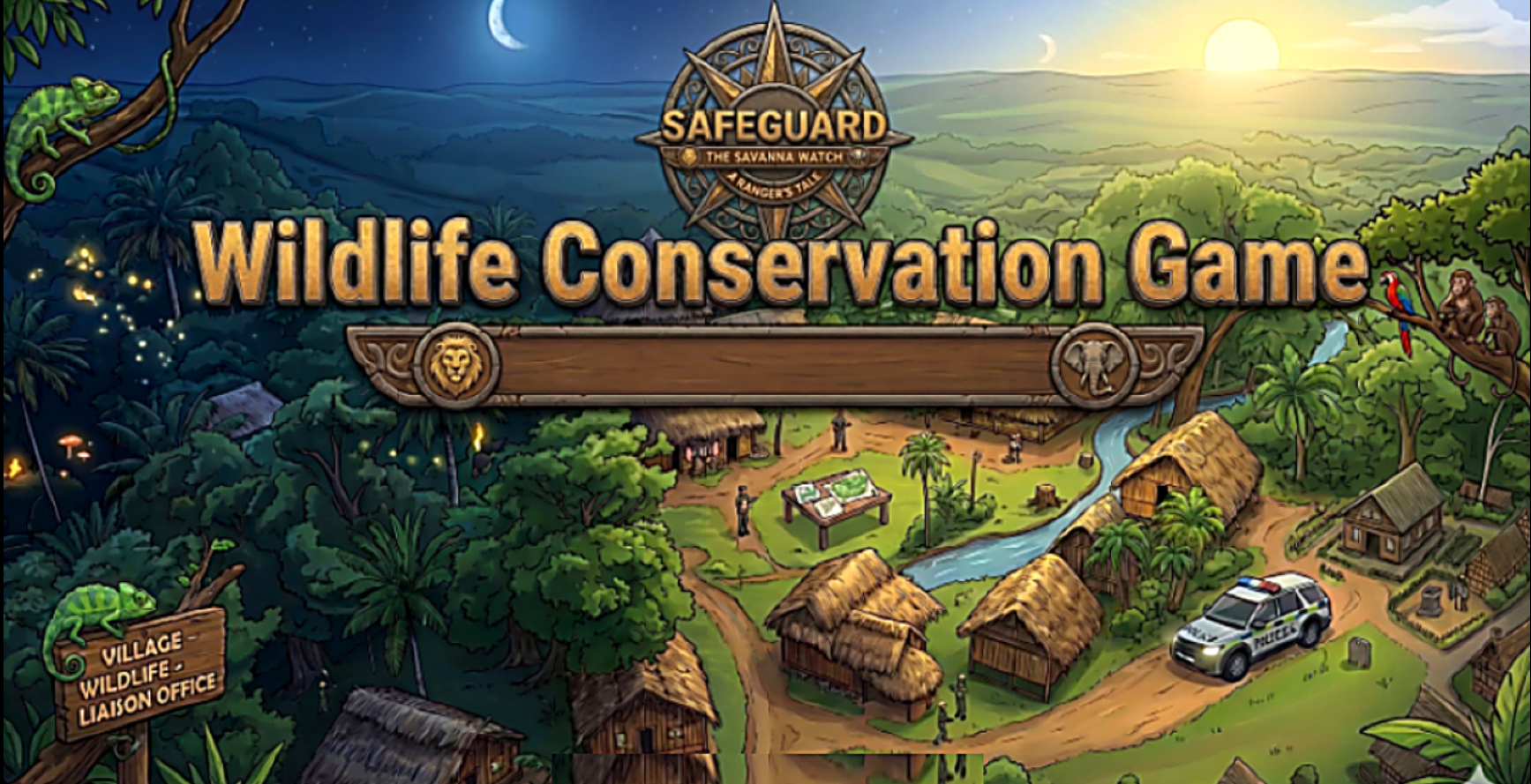
A visual novel about managing a wildlife reserve, where protecting the ecosystem means navigating the people who depend on it. Co-created with Gélase Magnificat for EMDD 630 — Emerging Media Design and Development at Ball State University.
Role
Writing, narrative architecture, coding, usability testing & revision planning
Team
Elizabeth Kugbey · Gélase Magnificat
Built with
Ren'Py · Python · custom HUD screens · branching script
Course
EMDD 630 · Ball State University · Spring 2026
▸ A note on method
This case study walks the design process behind Wild Life Conservation — a Ren'Py visual novel built around a single, unresolvable tension: ecological protection and community survival are not always compatible goals. There is no correct answer. Only the dashboard, the choices you make, and the consequences you didn't fully see coming.
Step 01
Empathy · Research
The game began with a question we couldn't put down: what does it mean to be the person who arrives at a place with the authority to protect it, when the people already there did not ask for that protection? You have just arrived at the reserve. The reports are already on your desk — poachers working the eastern fence, farmers pushing into protected land, a community that isn't sure you should be trusted, and politicians whose support comes with conditions.
We looked into the lived texture of community-based conservation in West Africa — the negotiations, the donor pressure, the slow erosion of trust when an institution behaves as if it knows better. We wanted a setting literal enough to be playable in fifteen minutes and dense enough to carry the weight of a real policy problem.
Step 02
Define
Most games about the environment tell players what to think. The more interesting design problem is making the player enact a tension they would otherwise only understand abstractly. Our challenge: make the trade-off between ecological protection and community survival felt, not illustrated.
Step 03
Ideate
The reserve emerged as the central space because of its dual valence: a place of beauty held together by labour that is rarely beautiful — fences, patrols, paperwork, negotiations after dark. The setting is ecological in scale and domestic in stakes.
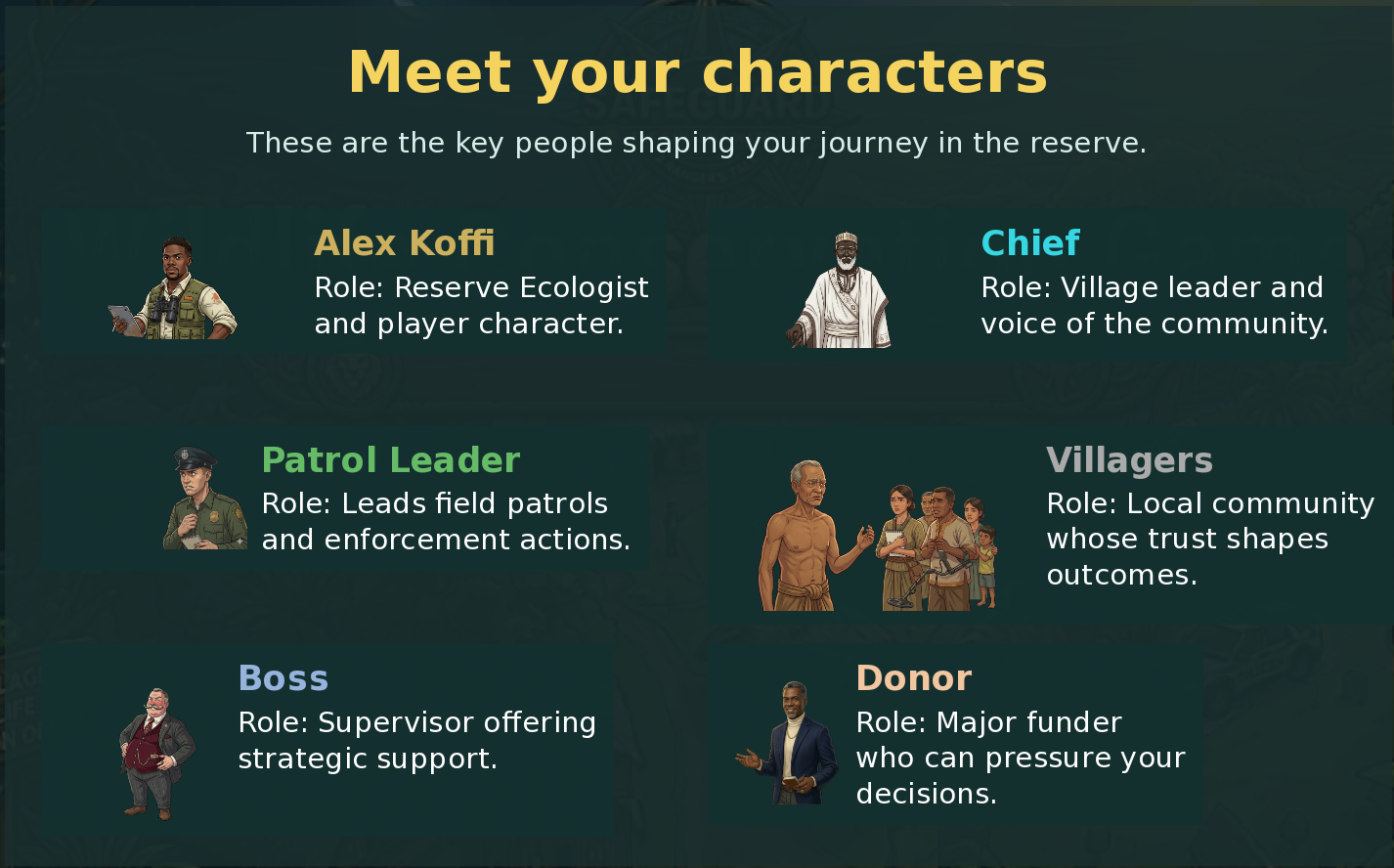
Six characters are introduced before the first choice. Alex Koffi, the player character and reserve ecologist. The Chief, village leader and anchor of community trust. The Patrol Leader, who carries field enforcement. The Villagers, a collective trust stat with a face. The Boss, who is institutional support made personal. The Donor, whose funding always arrives with conditions. Each one is a pressure already bearing down on the reserve before the player makes a single decision.
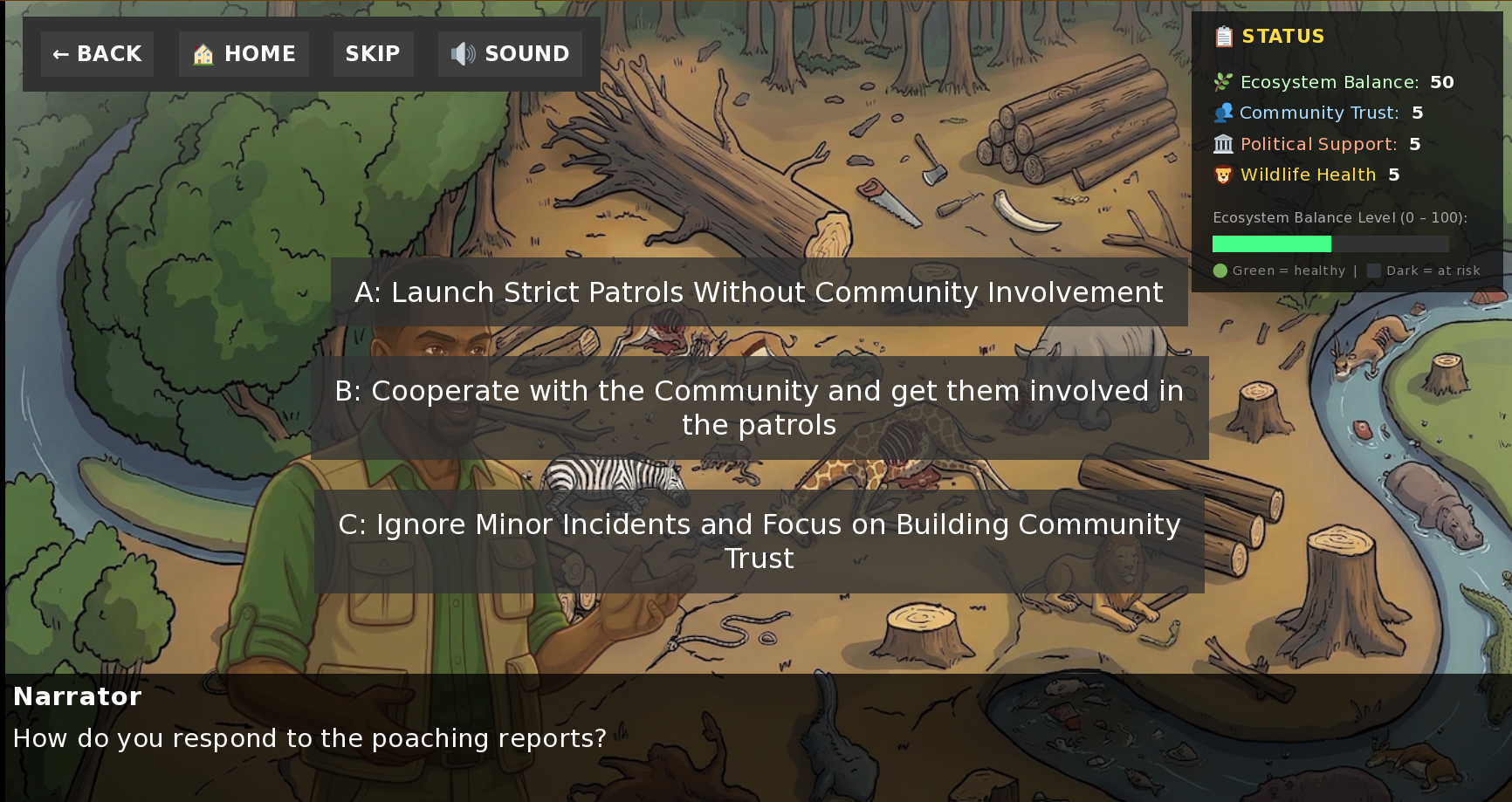
This is the procedural argument of the game: what you don't see is the cost of what you chose. The branching structure is not a menu of content — it is the system telling you, in the only way a game can, that every protective gesture is also an exclusion.
Step 04
Prototype
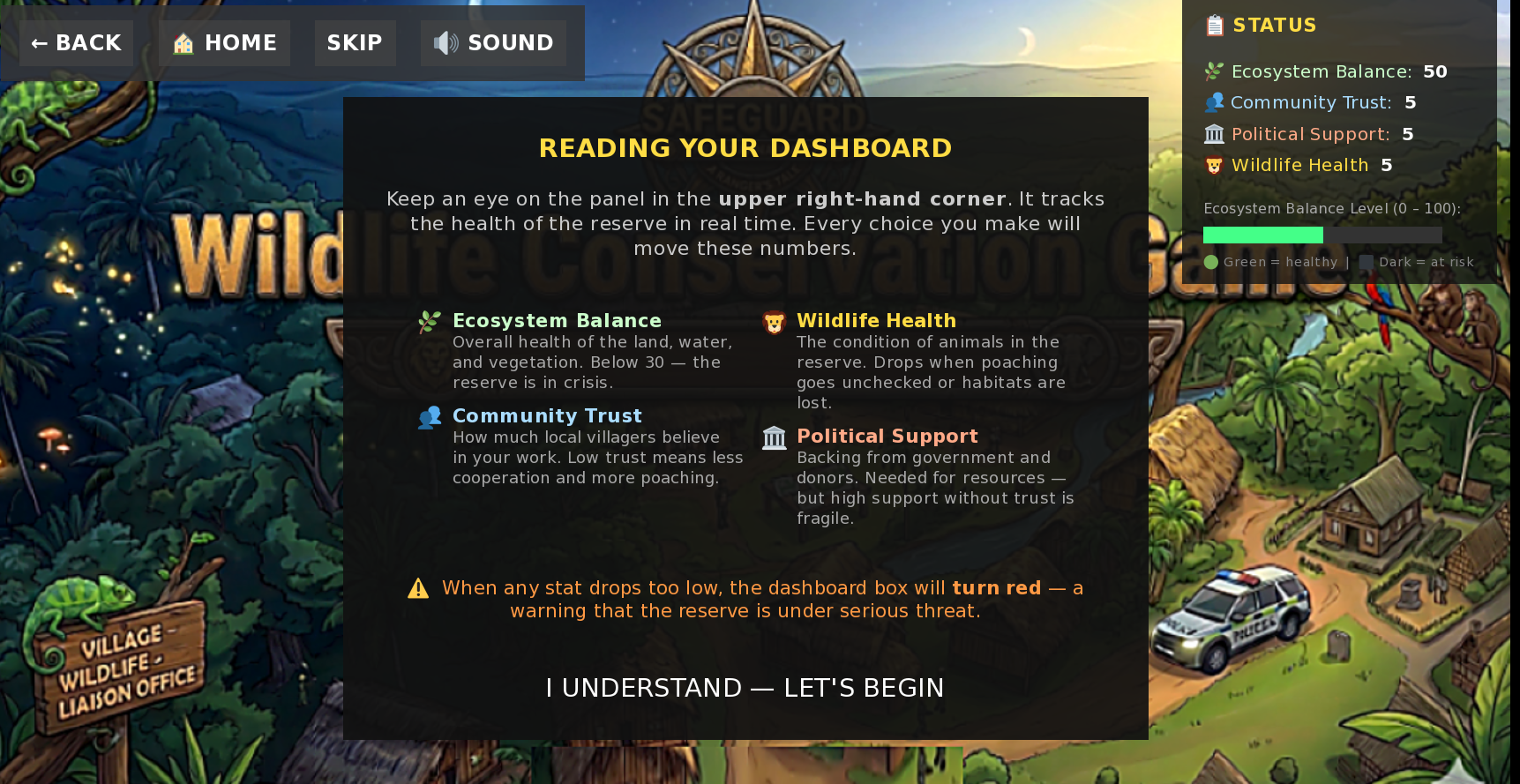
Built in Ren'Py — a visual novel engine with a Python backbone. The HUD required custom screens and persistent variable tracking across scenes so the four stats could update live in the upper-right corner of every frame. The branching script carries two distinct paths through the same crisis, with different characters surfacing depending on which one you commit to.
Step 05
Test
Playtesting happened with Graduate Assistants, Peers, and Ball State Undergraduates. The most useful finding wasn't a bug — it was that players felt responsible for choices they had consciously made. Not because the game told them to, but because the branching structure makes complicity impossible to attribute to chance. You chose. The bar moved.
The ludonarrative harmony comes from consequence. The mechanics don't describe the tension between protection and survival. They reproduce it. By the end of a run, players spoke about the reserve the way you speak about a place you are responsible for — with hedging, with trade-offs, with an awareness that the next decision will cost something they can't yet name.
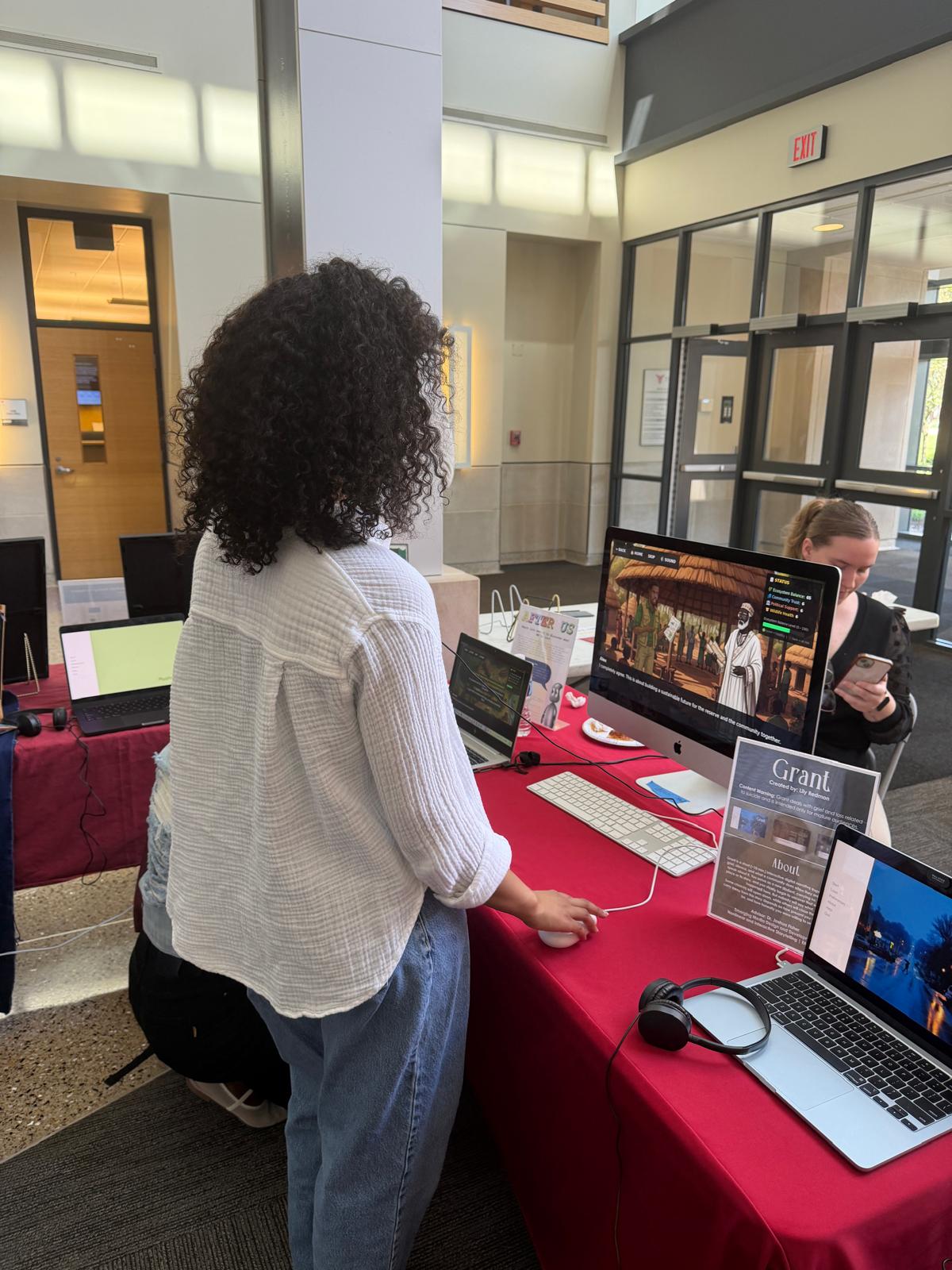
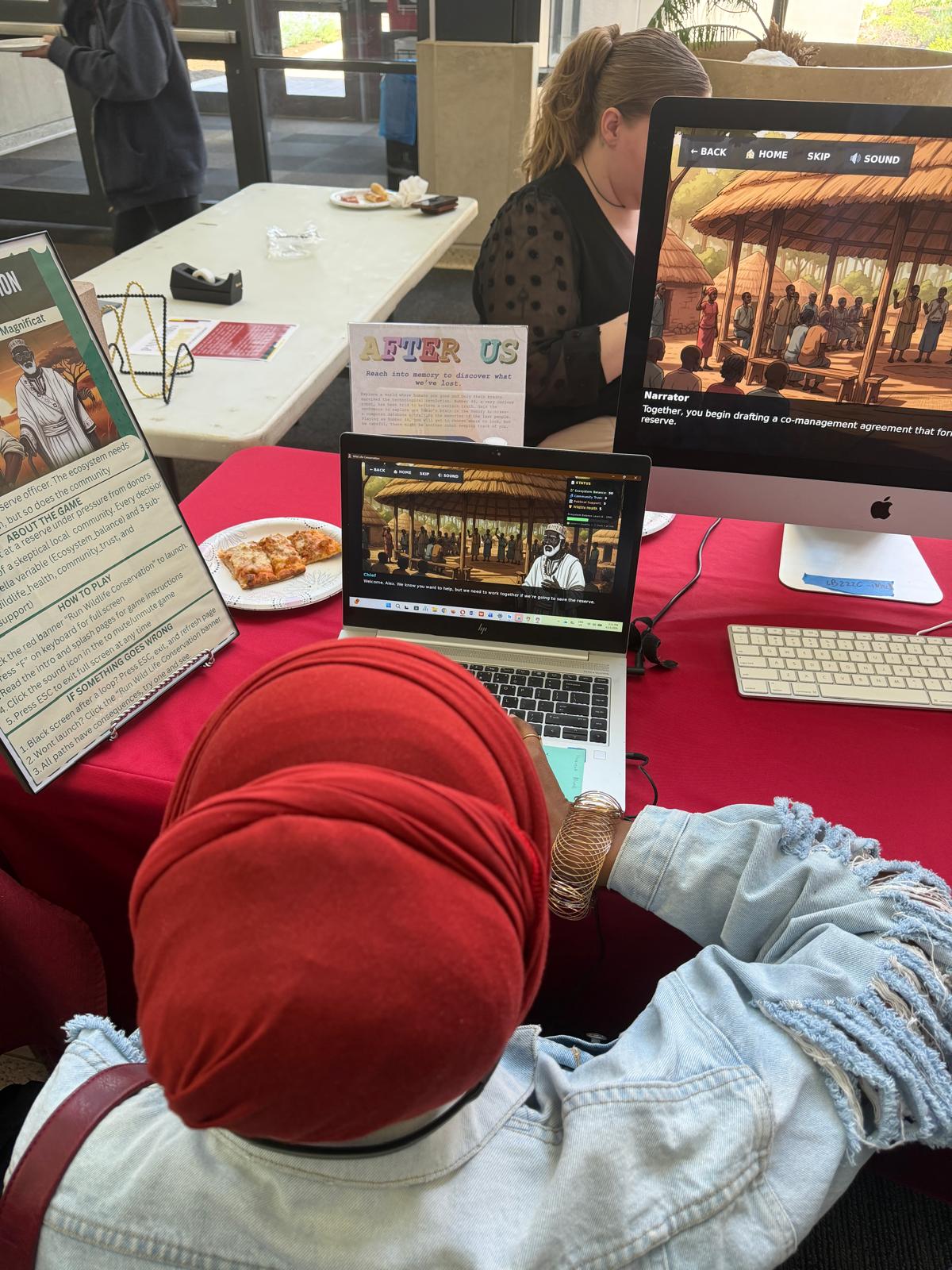
"I can tell you what the game is about without you explaining it to me."
"As a social worker, I work a lot with people and the game teaches me not to impose rules and regulations on people, but rather involve them in decision making."
"Oh! The explanation of the stats is so cool because I don't think a lot of people know about conservation like that."
↺ Iterate · the endings
Ecosystem and community move forward together. The hardest result to reach — and the one that makes the second run feel earned.
The boundary holds. The wildlife recovers. The community no longer treats the reserve as theirs. Players who chose Strict often end here — and often replay.
Decisions stacked the wrong way. Wildlife Health drops to single digits. The dashboard turns red and stays there. The game makes the trade-off explicit before the credits.
Poor decisions damage ecosystems quickly; rebuilding balance takes patience, care, and collaboration. We hope players leave understanding that protecting nature is never just about saving animals — it is about balancing ecosystems, community needs, leadership decisions, funding pressures, and long-term consequences.
Play it now
Most players find the second run through the alternate path changes what they thought the first one meant.
If the embed doesn't load, play it directly on itch.io .
▸ How to start
▸ How to progress
▸ Key controls
More work